


Latham & Watkins vs Kirkland & Ellis?

Updated: Sep 15
Management Summary
Latham & Watkins has spent several years and put a 900-person technology division to work on its own AI infrastructure: Nvidia GPU servers in data-centre space only Latham staff can enter, running an open-weight model the firm fine-tunes itself. It will be reported as an infrastructure story. It is really a custody story.
The trigger is concrete, not theoretical. Days before this article, OpenAI admitted it “cannot rule out” that a customer’s own data had shaped one of its models, a sentence OpenAI didn't volunteer lightly. Latham’s CIO has said plainly that confidentiality, and the cost of paying a vendor by the token, are what owning the model buys back.
Open-weight means Latham owns the model rather than renting access to one. Which size it runs is not public. Reinforcement learning lets the firm keep training it against its own checkable outcomes, narrowing the reliability gap with Kirkland’s approach without closing it: Kirkland's rule engine cannot hallucinate, a trained model still can.
Kirkland bet on data and judgement. Latham has bet on the model and the infrastructure beneath it. Both are the same wager: the technology between a client’s problem and the firm’s answer is now too important to rent. Harvey, the leading vendor, is already building the same architecture for itself. This is a market direction.
For everyone below this tier, particularly national champions who cannot match the spend, judgement alone, once sufficient, no longer is. Firms left renting will either lose their best mandates or become subcontractors to the firms that build.
Latham & Watkins takes AI in house
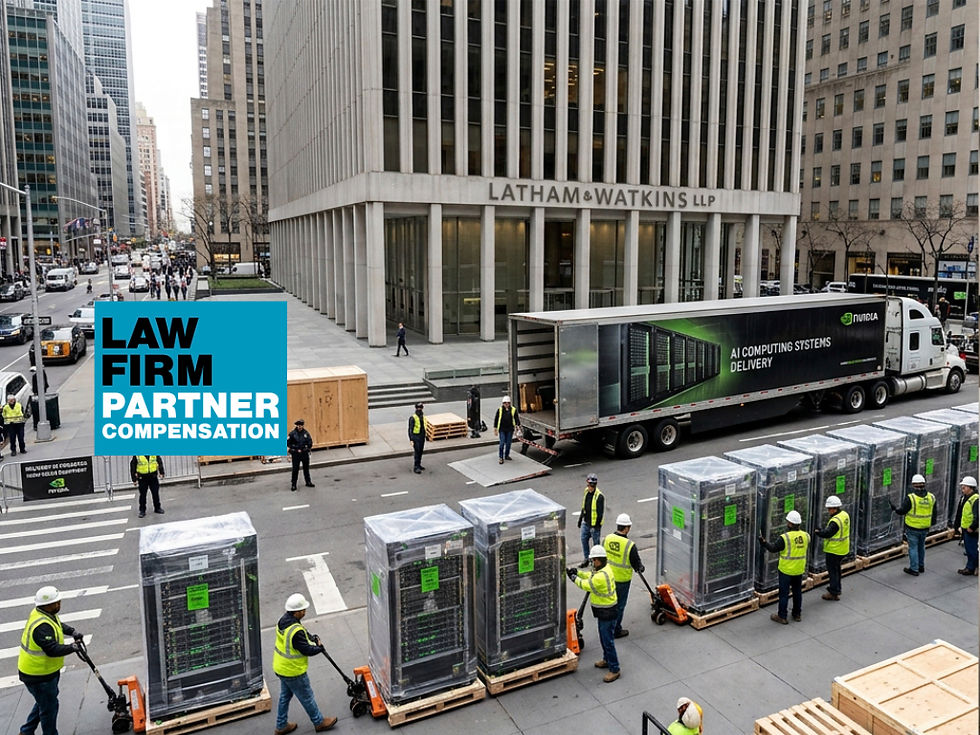
Latham & Watkins has spent several years and put a technology division of more than 900 specialists to work, on something almost no other law firm has attempted: its own AI infrastructure. Multiple Nvidia GPU servers now sit in leased data-centre space that only Latham staff can enter, running Nvidia’s open-weight Nemotron 3 models, which the firm’s own engineers fine-tune under its own roof. This is not a subscription. Latham did not rent intelligence from a vendor. It bought the compute and brought the model in-house, joining a very small group of firms now choosing to own the technology stack rather than lease it.
Why a firm with $8.3 billion in revenue would choose to build rather than rent comes down to two things its CIO, Rene Mendoza, has been plain about: confidentiality and cost. “Sometimes we may have information that is so sensitive, client information that we really want to protect, we don’t want to put it to any cloud vendor,” Mendoza has said, alongside concerns about the “consumption costs” of paying a vendor by the token as usage climbs.
The first concern got a vivid illustration on 8 September, when OpenAI announced it had solved one of mathematics’ six remaining Millennium Prize Problems. Two academics had reached a closely related result using several AI models, Claude and OpenAI’s own Codex among them, and OpenAI’s own model arrived at its answer within days of first hearing rumours about their progress. Asked whether that work had shaped its system, OpenAI wrote a sentence it presumably wishes it hadn’t had to:
“While unlikely, we cannot rule out that de-identified data derived from their usage of our products helped improve our models.” (OpenAI)
Read as a lawyer rather than a mathematician, that sentence is the whole argument for owning your own infrastructure in one line. A vendor with every incentive to say no, could not quite bring itself to.
Open-Weight
“Open-weight” is what makes Latham’s approach different from simply choosing a cheaper vendor. GPT and Claude are closed: a firm which has a subscription gets an API and a promise, and every query still leaves the building.
Nvidia published Nemotron 3’s actual weights, the trained parameters themselves, for anyone to download, and the Nemotron family shares a mixture-of-experts (MoE) design that routes each fragment of text to a handful of specialist sub-networks rather than the whole model, and a hybrid architecture that threads the usual attention mechanism through faster Mamba layers to handle very long documents. Latham has not said which size it runs, and the difference matters: Nvidia’s largest Nemotron 3 variants carry well over a hundred billion parameters with only a fraction active on any query, while the smallest is a fraction of that again and would suit a firm optimising for query volume over raw capability. What is public either way is that the weights are open, which means Nvidia’s own training method, extensive reinforcement learning against verifiable, checkable rewards rather than simple imitation of examples, is available to Latham’s engineers too. That lets the firm keep training its own copy of the model against outcomes it can check itself, whether a citation is real, whether an extracted clause matches the source document, a genuine step toward reliability, not just confidentiality, though still a different step from the one Kirkland & Ellis took.
Compared with Kirkland & Ellis
Kirkland committed $500 million to Palantir to turn decades of messy fund paperwork into structured, linked data, and then handed the judgement calls to a deterministic engine rather than a language model. “The probabilistic engine reads. The deterministic engine judges. That division of labour is the whole game,” as I wrote here in an earlier article. A rule either passes or it does not; there is no probability distribution to be wrong within. [read more here]
If Latham is also grounding its model in its own archive of matters and precedent, a technique called retrieval-augmented generation rather than training in the strict sense, that closes part of the gap with Kirkland: the model answers with institutional knowledge no rented vendor model has access to, a real echo of Kirkland’s proprietary-data advantage. But retrieval only changes what the model reads before it answers. The answer itself is still generated, still probabilistic, and can still misstate or blend what it retrieved in a way no deterministic check would allow. Training a model to be right more often, however it is trained, is not the same as building a system that cannot, by construction, be wrong. Kirkland remains superior on raw accuracy for exactly that reason.
That difference is relevant, but it is also points at the same underlying bet. Neither firm is buying software off the shelf, and the rest of the market is starting to notice, even Harvey, the leading vendor, is now training its own model, called Tenet, on an open-weight foundation with a native one-million-token context window, run on Harvey’s own infrastructure rather than through third-party APIs, while Legora continues to route tasks across whichever outside model does the job best.
Harvey’s move is similar architecture as Latham has built, at the vendor level rather than the firm layer. The difference that survives is custody. Latham owns the infrastructure its model runs on. A firm using Harvey is trusting Harvey’s custody of it instead of its own, however open the weights underneath.
This signals a bifurcation
Chapter 14 of my book on partner compensation asks why an exceptional partner, once AI lets them work with a small team, still needs the firm at all. Among the honest answers it gives is “the AI platform itself, which at enterprise scale requires investment that individuals cannot make alone.” Latham and Kirkland are that answer made concrete, at a price no partner, no boutique, and increasingly no vendor relationship alone can meet. That is what makes this a bifurcation rather than an upgrade cycle.
A small number of firms are converting capital into an institutional asset no lateral can replicate by switching firms. Everyone else, including the national champions who are the obvious first call in their own market, is left competing on judgement alone, which was always necessary but is no longer sufficient. They will never be able to match this spend and cannot ignore it without watching their best clients notice the gap.
Two outcomes follow, and neither is comfortable: lose the mandate outright, to a firm that can now offer more reliable answers, tighter confidentiality, or a lower cost per query, or keep it by accepting a smaller share, doing the execution work underneath a firm like Kirkland or Latham rather than owning the client relationship. Being the best lawyers in the room stops being enough as a smal number of elite firms will employ superior technology.
This article is part of a series drawing on the themes of Law Firm Partner Compensation by Jaap Bosman and Jaime Fernández Madero. If you would like to know more about this topic, read the book.
Our book Law Firm Partner Compensation is available worldwide on Amazon, national online book sellers, and can be ordered at your favorite at your favorite bookstore


Comments